—wins
Is that win rate actually impressive?
Enter the take-profit and the stop-loss — your risk-reward. You get the win rate at which a single trade breaks even. Below it, the system loses money no matter how high the win rate looks.
You are looking at a shared setup. Back to the calculator
Spread + slippage + commission. Leave at 0 if unsure
Enter it to get expectancy and margin
Win rate needed to break even
—
Wins needed to recover one loss
Expectancy per trade
—pips
Margin above break-even
—points
Share on social
How risk-reward sets your win rate
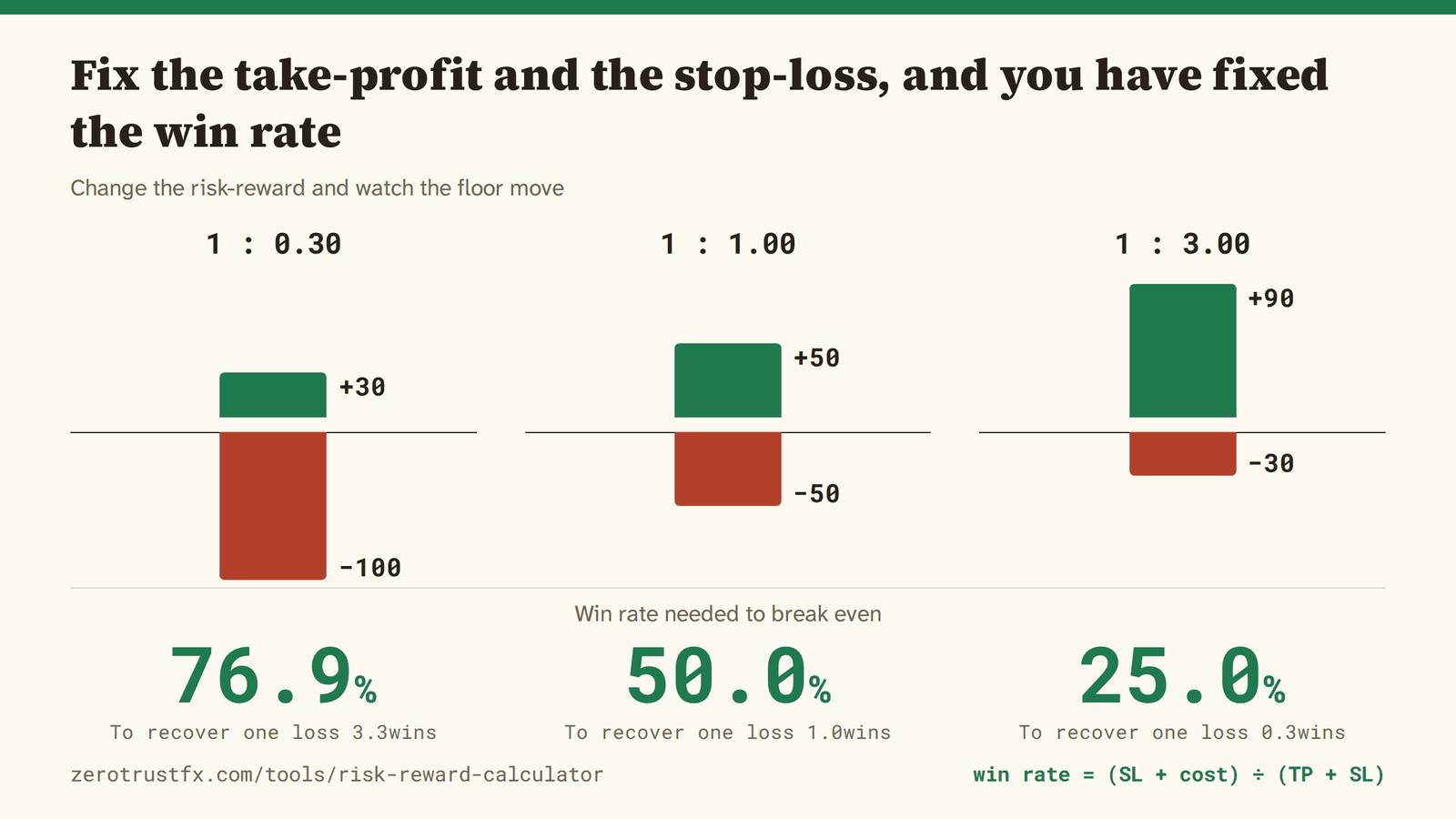
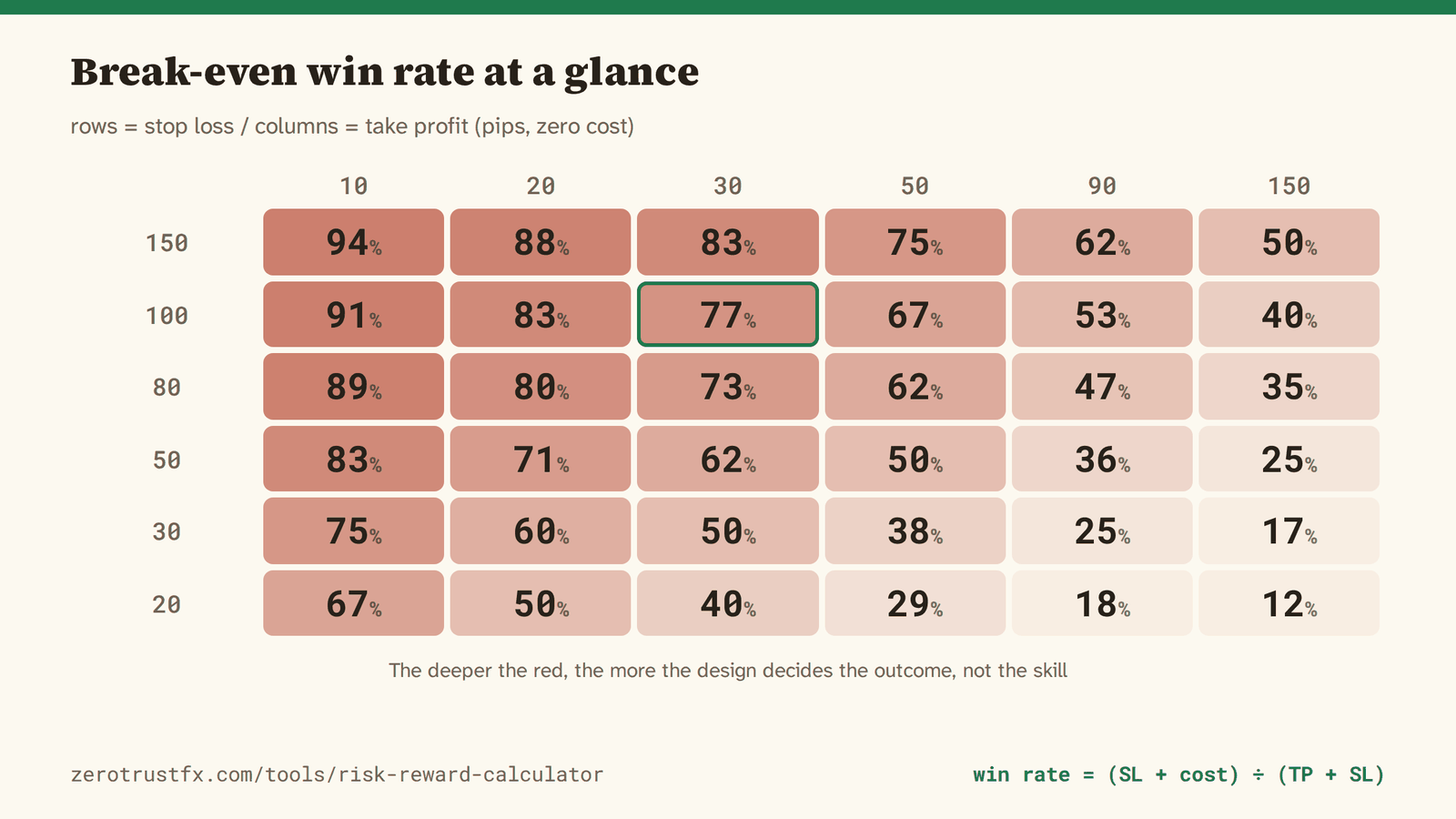
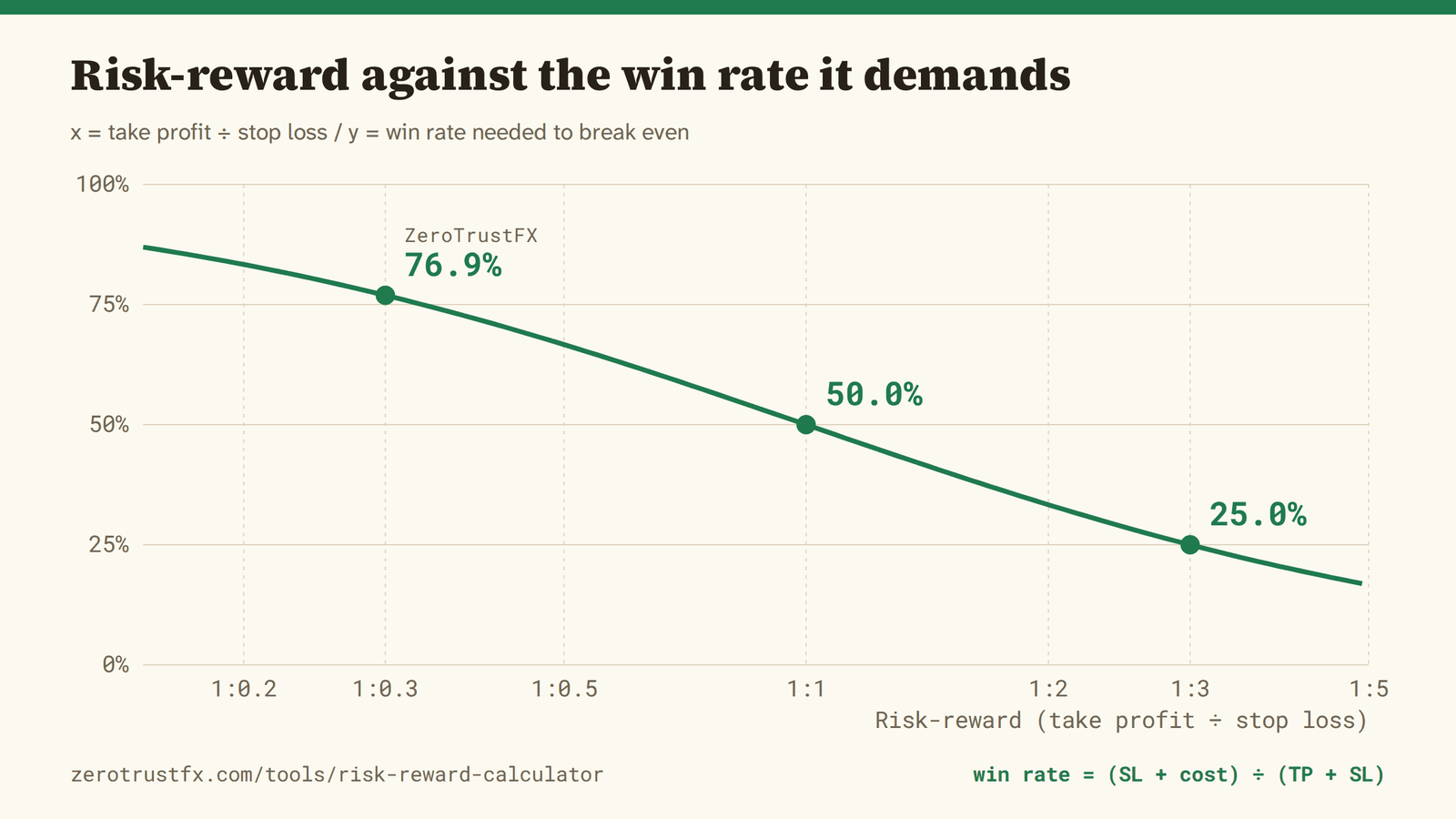
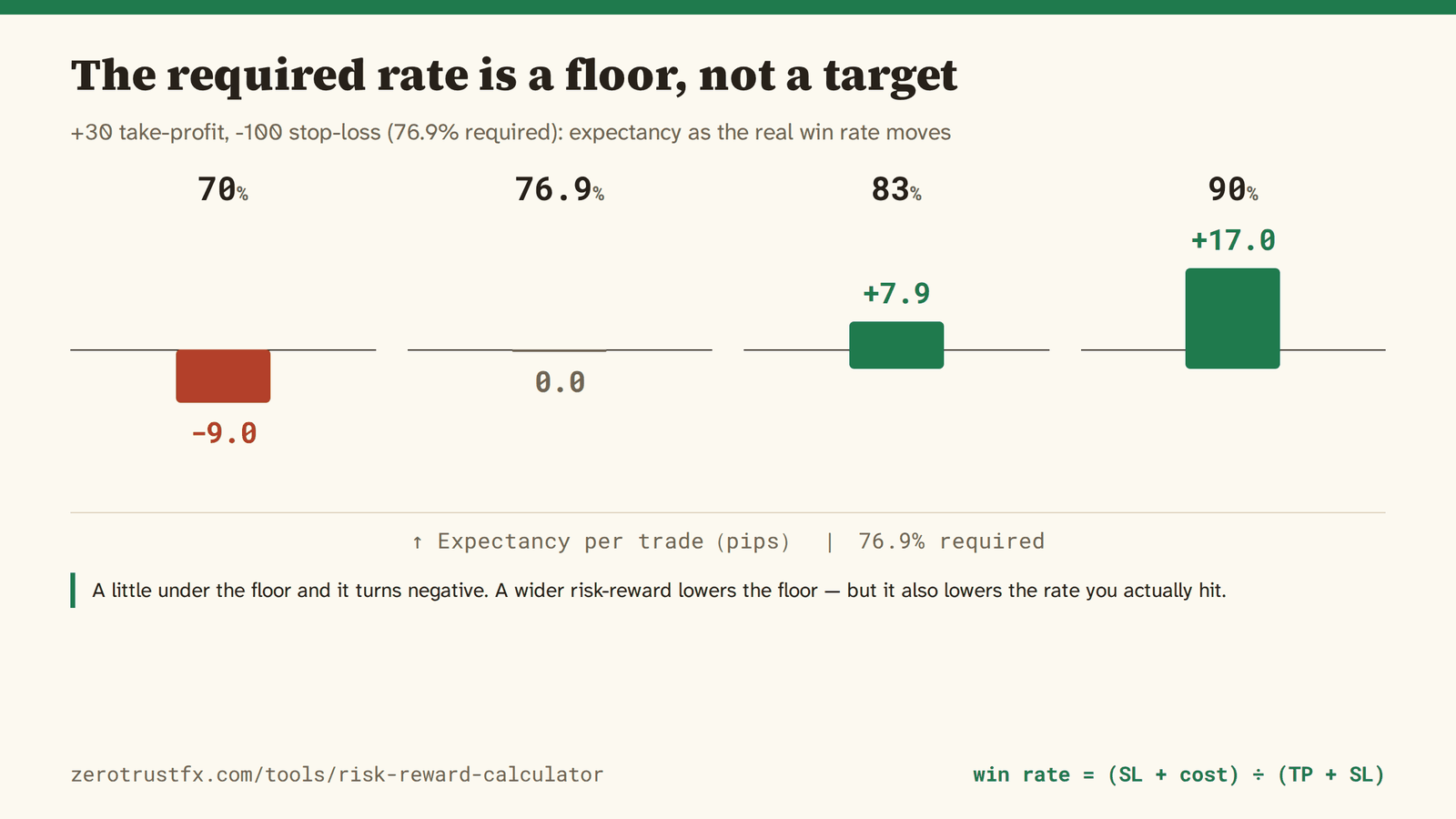
The moment you fix the take-profit and the stop-loss — the risk-reward — you have fixed the floor on the win rate. That floor is the breakeven win rate. Take +30 and cut −100 and you need 77% just to break even. So 83% is not proof of skill — it is the minimum that design needs in order to work at all.
When a forex advert says "90% win rate", ask for the take-profit and the stop-loss. Either you get no answer, or you find the required rate is above 90%. This is how most high win rate EAs and signal services are built — take small profits, cut large losses, and the percentage goes wherever you want.
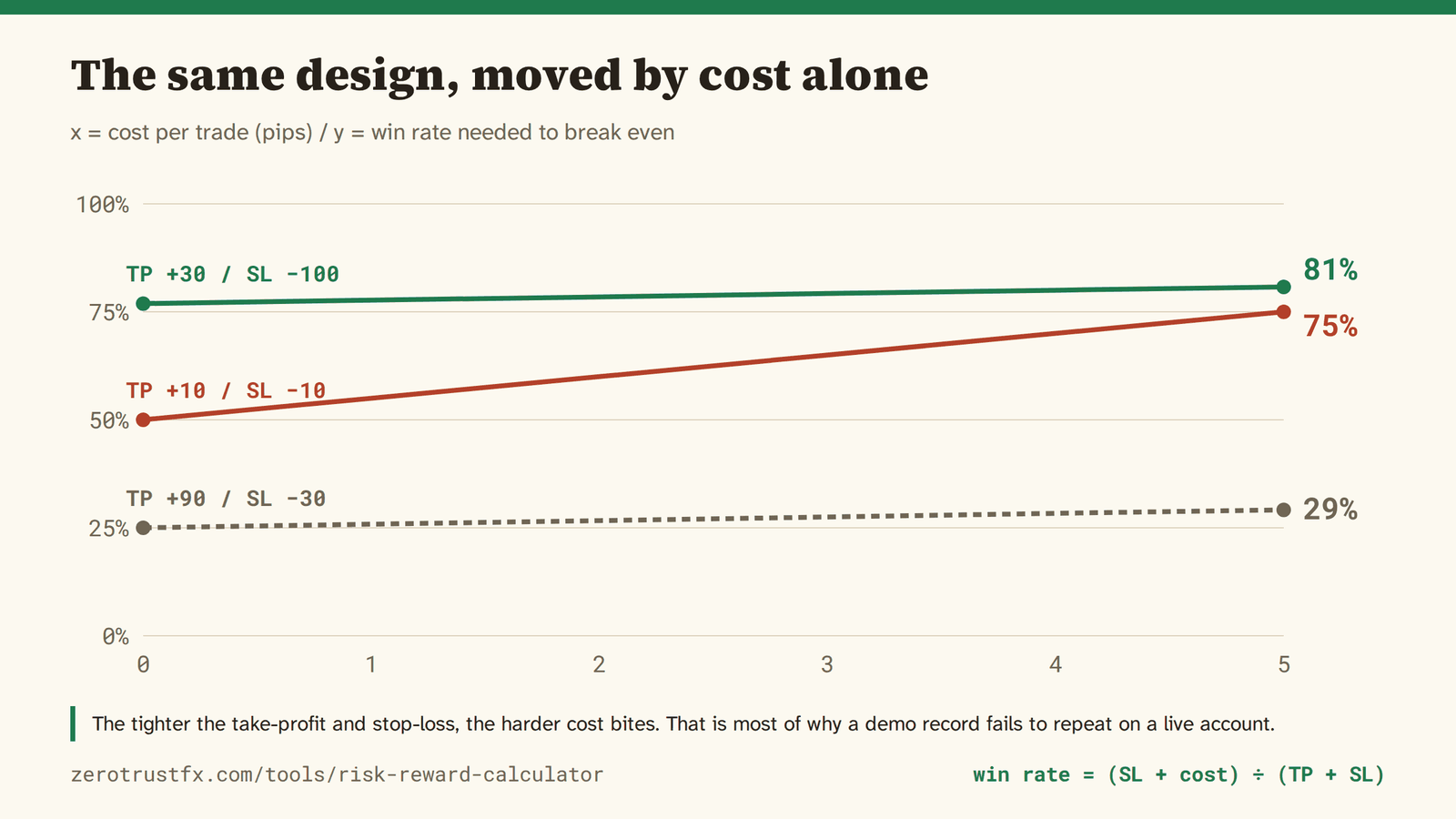
Put 2–3 pips into the cost field and watch the required rate climb. That is most of the reason a demo record fails to repeat on a live account.
Risk-reward in pictures
The formula
required win rate = (stop loss + cost) ÷ (take profit + stop loss)
expectancy = win rate × (take profit − cost) − (1 − win rate) × (stop loss + cost)
When a trade hits neither price
The formula above assumes every trade ends at one of the two prices you set. Many systems have a third exit: a time limit. When it expires the position closes at the market price of that moment — usually somewhere between the target and the stop, and neither a win nor a loss at full size.
That third outcome takes probability away from both sides, so a win rate stops being a single number. Count only the trades that reached a price and you get one percentage. Count every closed trade and you get a lower one. Both are true, and they answer different questions. A figure quoted without saying which denominator it uses is not an answer to either.
The system published on this site runs 24 combinations of currency pair and direction. Twenty use +30 / −100 and four use +15 / −50. The stop is 3.33 times the target in both cases, so all 24 need the same 76.9%. That is deliberate: one number to clear across the whole system, so no single combination can be held up as the good one. Ask for the same three things before believing any win rate — the two prices, what happens when neither is hit, and which denominator the percentage uses.
Cost pushes the required win rate up
In the formula above, cost sits in the numerator. With a 50 pip target and a 50 pip stop, one pip of cost per trade lifts the required win rate from 50% to 51%. Which broker you use is not outside this calculation — it is inside it. The trading record published on this site is an Exness account.
※ This is an affiliate link: I earn a commission if you open an account through it, fund it and actually trade. That commission and a planned performance fee on a future copy-trading service are this site's only revenue — there is nothing else. Trading with leverage carries the risk of losing your money.
Common questions
With a 1:3 risk-reward, what win rate do I need?
With a 30-pip stop and a 90-pip target, 25%. Add one pip of cost and it becomes 25.8%. The 1:3 preset above runs the same calculation.
Is a 90% win rate impressive?
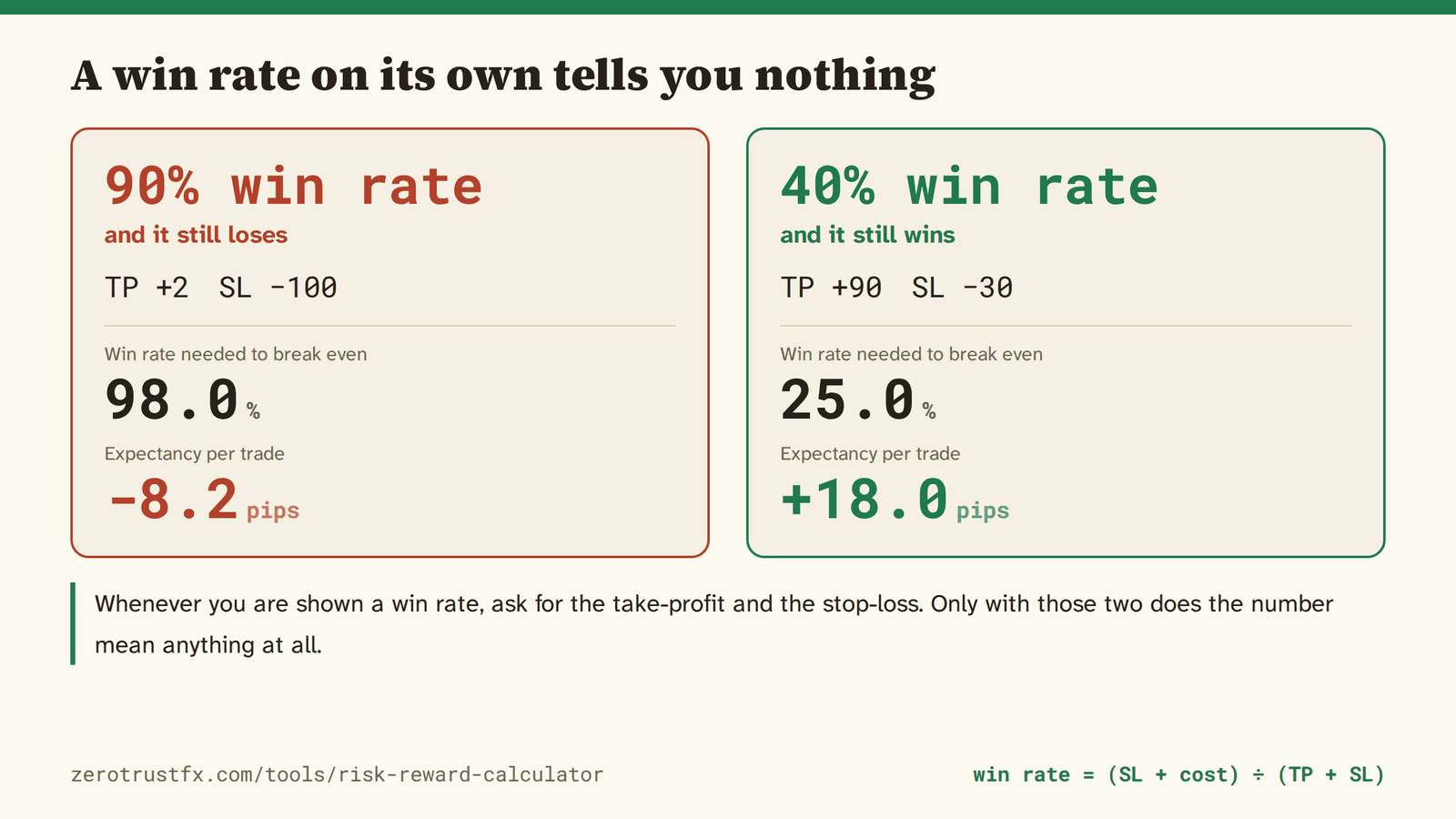
It depends entirely on the take-profit and the stop-loss. Take 2 pips and cut 100 and you need 98% just to break even — at 90% you lose 8.2 pips per trade. Take 90 and cut 30 and you only need 25%, so even 40% is comfortably profitable. A win rate on its own tells you nothing.
Why do forex EAs and signal services show such high win rates?
Because a win rate can be engineered. Take small profits, cut large losses, and the percentage goes wherever you want. Whenever someone shows you a win rate, ask for the take-profit and the stop-loss, and put them in here.
With a 1:1 risk-reward, what win rate do I need?
50% if your costs are zero — a 50 pip take-profit against a 50 pip stop-loss. Add 1 pip of spread and commission and it becomes 51%. If you treat a 50% win rate as a coin flip, you are in fact losing slowly.
With a 1:2 risk-reward, what win rate do I need?
33.3%. A 100 pip take-profit against a 50 pip stop-loss breaks even if you win one trade in three. Add 1 pip of cost and it becomes 34.0%. The 1:2 preset above runs the same calculation.
How do I calculate risk-reward?
Take-profit divided by stop-loss. A 90 pip target against a 30 pip stop is 90 ÷ 30 = 3, written 1:3. This calculator does not return the ratio itself — it returns the win rate that ratio requires. Same ratio, same answer, whether you count in pips or in money.
Why do I still lose with a 50% win rate?
Because your target is smaller than your stop. A 30 pip take-profit against a 40 pip stop-loss needs 57.1% just to break even — at 50% you lose 5 pips per trade. The question is never whether you win half the time; it is whether you clear the rate your design requires.
How much do spread and commission move the required win rate?
The smaller your targets, the more they matter. On a 10 pip target against a 10 pip stop, 2 pips of cost raises the required win rate from 50% to 60%. The same 2 pips on a 100 pip target against a 100 pip stop moves it from 50% to only 51%. That is why cost hurts scalping most.
How is expected value (EV) calculated?
EV = win rate × (take-profit − cost) − (1 − win rate) × (stop-loss + cost). With a 90 pip target, a 30 pip stop and a 40% win rate: 0.4 × 90 − 0.6 × 30 = +18 pips. A 40% win rate can be solidly profitable. Fill in the optional "actual win rate" field and this runs alongside.
How does this relate to profit factor?
Profit factor is gross profit ÷ gross loss, and it falls out of the win rate and the ratio. At a 40% win rate with a 90 pip target and a 30 pip stop: (0.4 × 90) ÷ (0.6 × 30) = 2.0. At exactly the required win rate, profit factor is 1.0 — break-even.
What is the ideal risk-reward ratio?
There isn't one. At 1:3 the required win rate drops to 25%, but a target that far out is reached less often. At 1:1 you need 50%, but you get there more easily. The only thing that decides it is whether your actual win rate clears the required one.
Can I enter money instead of pips?
Yes. The required win rate depends only on the ratio, so as long as the units match the answer is the same. A 300 dollar target against a 100 dollar stop is 1:3, so it needs 25% — the same number as 90 pips against 30. Enter your cost in that same unit.
After ten losses in a row, how many wins do I need?
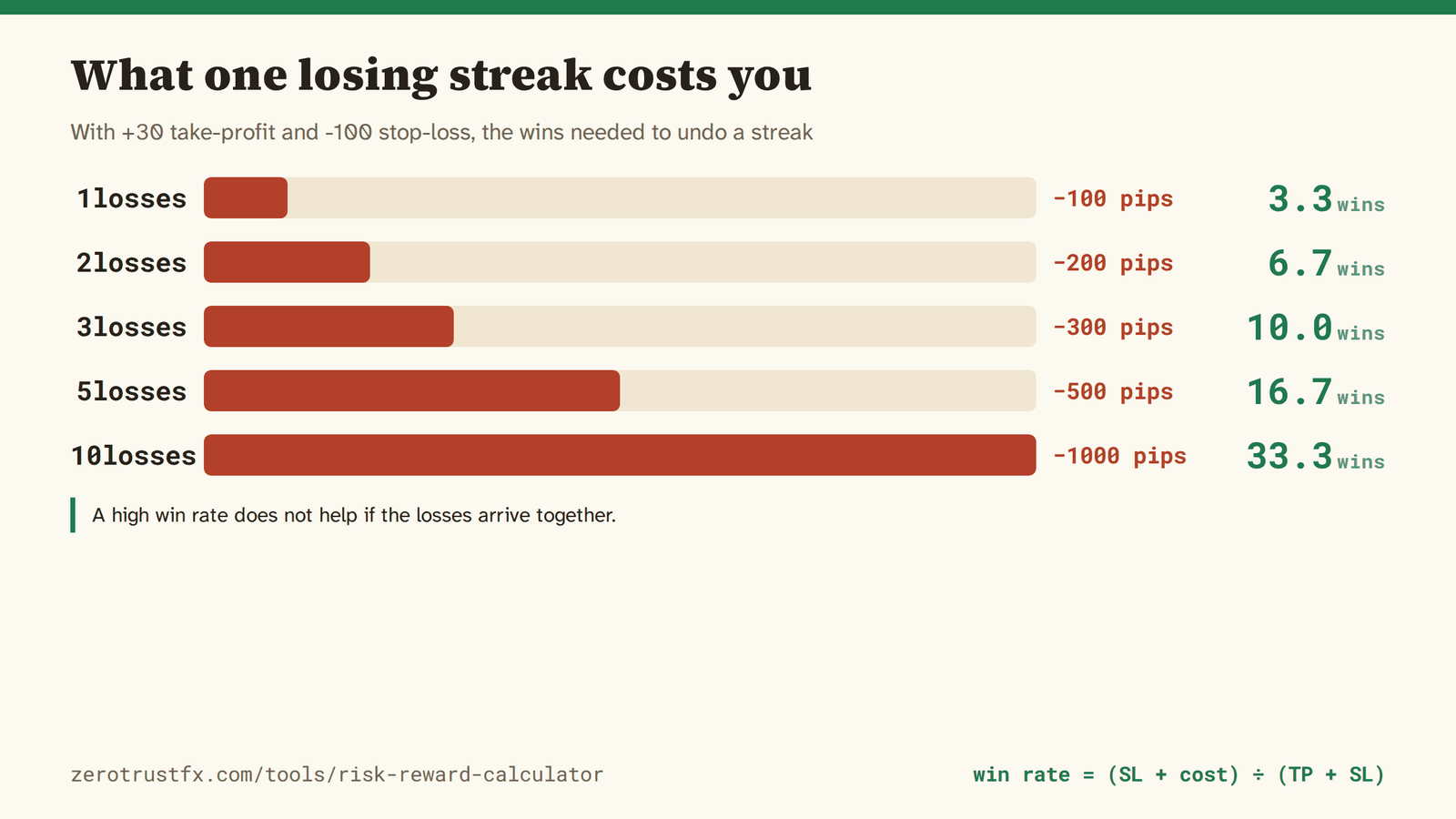
With a 30 pip target and a 100 pip stop, ten losses is −1,000 pips, and it takes 34 winning trades at +30 to get back to where you started. The "wins needed to undo one loss" field is that number — the lower your risk-reward, the heavier the cleanup after a streak.
Why does a higher risk-reward come with a lower win rate?
The further out your target sits, the more often price turns back before reaching it. The required win rate falls, but your actual win rate falls with it. This calculator only gives you the first number; the second has to come from your own record. You need both side by side before you can judge anything.
What does this calculator guarantee?
Nothing. It gives you one thing: the minimum condition for a design not to lose. Clearing the required win rate does not protect you from position sizing or from the depth of a losing streak. Falling short of it means you lose over time, however good a short run looks.
What happens to trades that hit neither the take-profit nor the stop-loss?
They close some other way — most often on a time limit, at whatever the market price is at that moment. The result lands between the target and the stop, so it is neither a full win nor a full loss. The formula on this page does not model that third outcome; it assumes every trade ends at one of the two prices. If the system you are looking at has a time limit, ask how often it fires and what the average result is.
Which denominator should a win rate use?
Whichever one you say out loud. Wins divided by the trades that reached the take-profit or the stop-loss gives one number. The same wins divided by every closed trade gives a lower one. Neither is wrong — they answer different questions. A win rate quoted with no denominator is the easiest way to make an ordinary record look good.
Check this against a real record
A required win rate is arithmetic on paper. ZeroTrustFX publishes every trade before its outcome is known, cross-checked by an independent third party. You can see there how the arithmetic above meets an actual record.
※ This is an affiliate link: I earn a commission if you open an account through it, fund it and actually trade. That commission and a planned performance fee on a future copy-trading service are this site's only revenue — there is nothing else. Trading with leverage carries the risk of losing your money.