—lots
Size with "$10 a pip" and gold is 10x off, USTEC is 100x off
Unlike a currency pair such as EUR/USD, gold and silver, crypto pairs like BTC and ETH, oil, and CFDs such as US30 and the Nasdaq are worth a completely different amount per pip. The same 50 pip stop can call for a lot size up to a hundred times larger. Enter your balance, your risk per trade and your stop, and the size comes out of one formula with no special cases. Picking an instrument fills in the contract size and the pip size, and both stay editable — they differ between brokers.
In your account currency
What you accept losing on this one trade
Distance from entry to the stop
Units in one lot. Differs between brokers
Price move of one pip. 0.0001 for EURUSD
One unit of quote currency in account currency. 1 if they match
Currency of the balance and the risk amount
Right-hand currency. Pip value comes out in this one
Your broker minimum lot increment. Usually 0.01
Instruments (fills contract size and pip size — both stay editable)
FX
Metals
Energy
Indices
Crypto
Lot size
—lots
Order size (after the lot step)
Actual risk
—USD
Actual risk (%)
—
Pip value per lot
—USD
Loss per lot
—USD
Target risk
—USD
Pip value and lot size, in pictures
How far pip value actually spreads
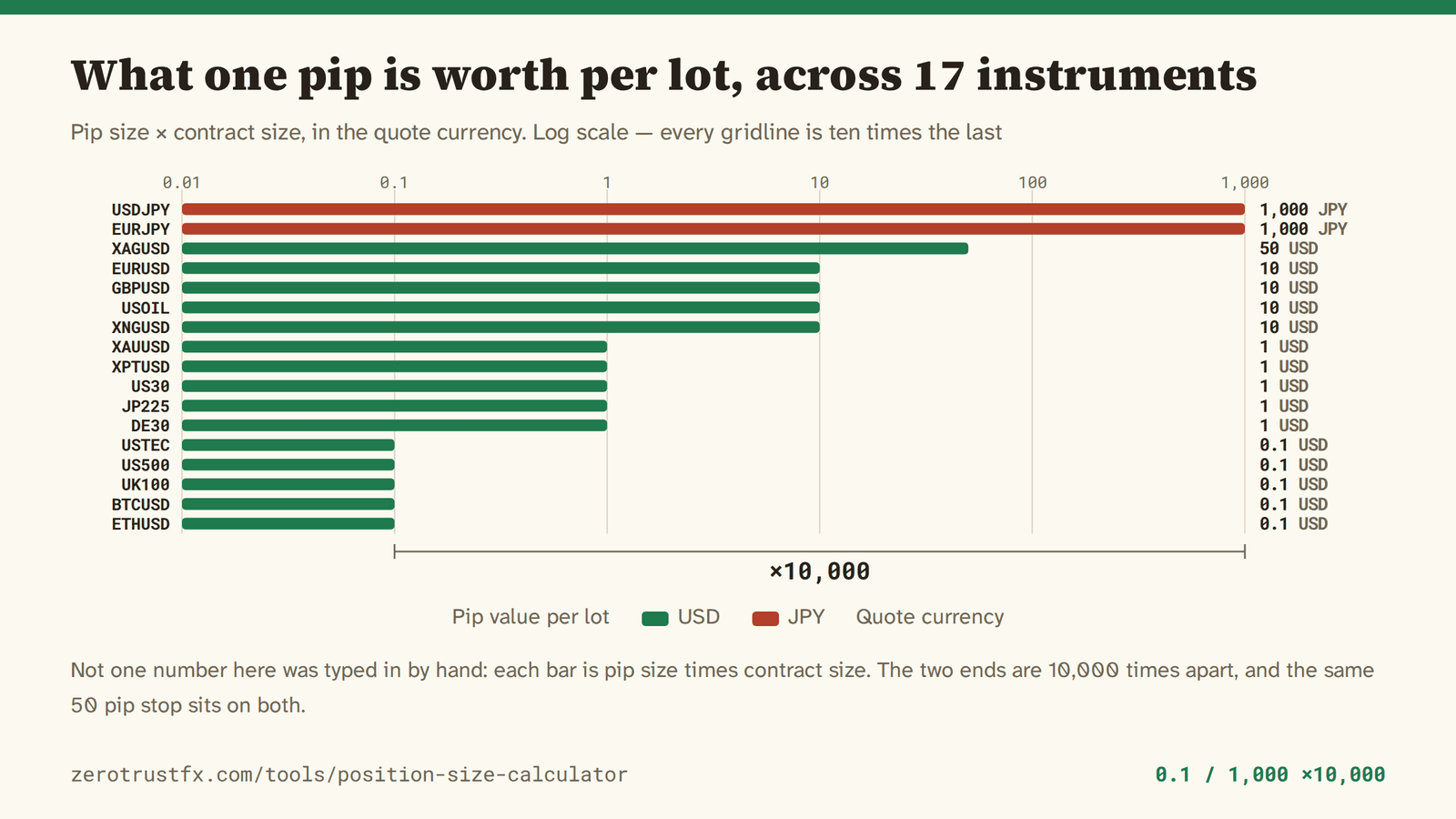
The table below is worked out from the balance, risk and stop you entered above. Pip value is nothing but pip size x contract size — not one number in it was typed in by hand.
| Symbol | Contract size | Pip size | Pip value per lot | Lot size | vs "$10 a pip" |
|---|---|---|---|---|---|
| EURUSD | 100,000 | 0.0001 | 10 USD | — | — |
| GBPUSD | 100,000 | 0.0001 | 10 USD | — | — |
| USDJPY | 100,000 | 0.01 | 1,000 JPY | — | — |
| EURJPY | 100,000 | 0.01 | 1,000 JPY | — | — |
| XAUUSD | 100 | 0.01 | 1 USD | — | — |
| XAGUSD | 5,000 | 0.01 | 50 USD | — | — |
| XPTUSD | 100 | 0.01 | 1 USD | — | — |
| USOIL | 1,000 | 0.01 | 10 USD | — | — |
| XNGUSD | 10,000 | 0.001 | 10 USD | — | — |
| US30 | 1 | 1 | 1 USD | — | — |
| USTEC | 1 | 0.1 | 0.1 USD | — | — |
| US500 | 1 | 0.1 | 0.1 USD | — | — |
| JP225 | 1 | 1 | 1 USD | — | — |
| DE30 | 1 | 1 | 1 USD | — | — |
| UK100 | 1 | 0.1 | 0.1 USD | — | — |
| BTCUSD | 1 | 0.1 | 0.1 USD | — | — |
| ETHUSD | 1 | 0.1 | 0.1 USD | — | — |
"needs rate" means the quote currency is not your account currency and the rate is unknown. Pick that instrument above and enter the conversion rate and the number appears.
The "vs "$10 a pip"" column is the correct lot size divided by the size "$10 a pip" gives. 1 means they agree; 10 means the "$10 a pip" answer is one tenth of the position you meant to take.
Why "$10 a pip" does not travel
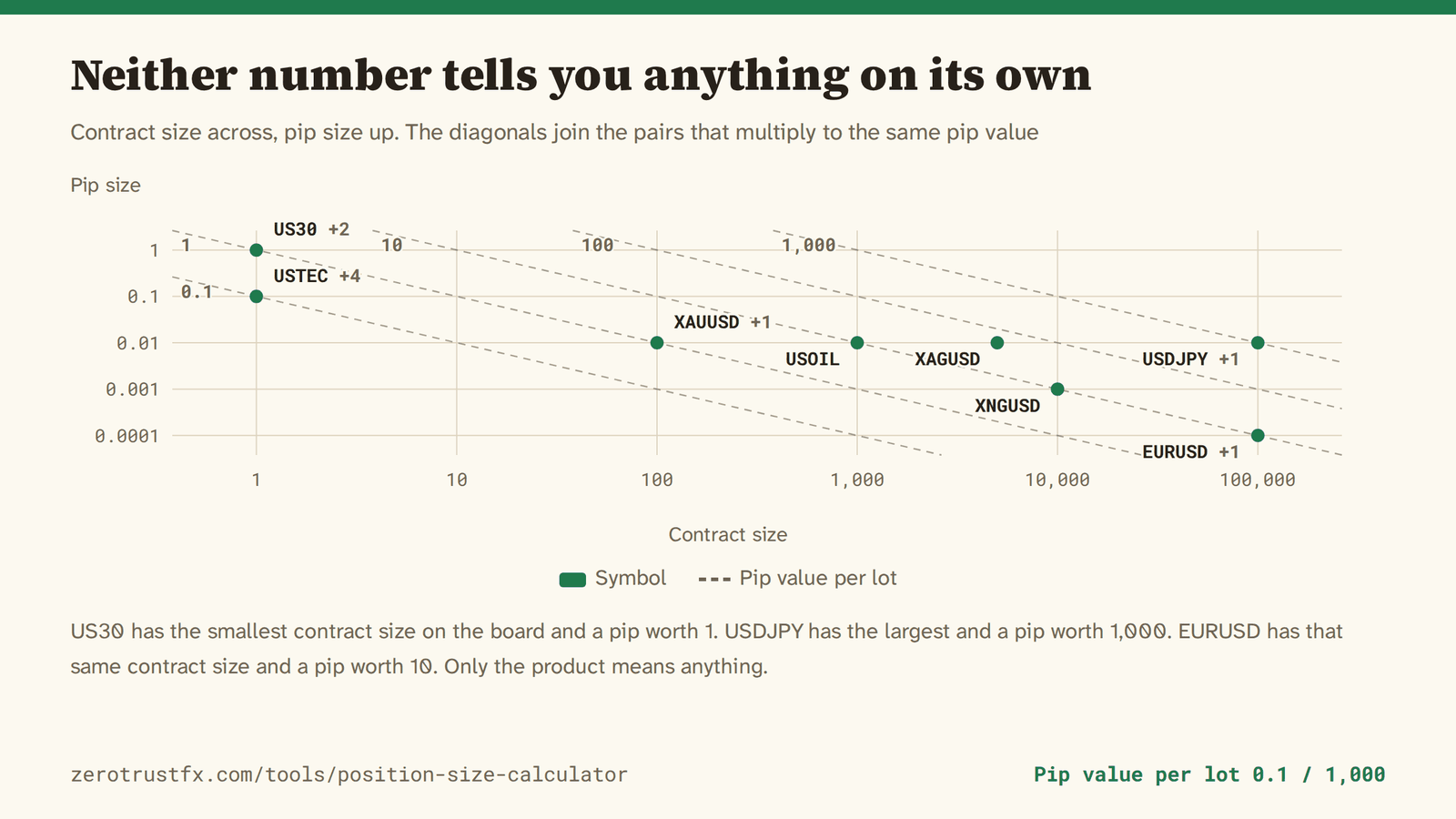
Pip value is not something to memorise. It is pip size x contract size and nothing else. For EURUSD that is 0.0001 x 100,000 = 10. That single product is where "$10 a pip" came from.
Run the same product across the rest and, over these 17 instruments alone, it spreads from 0.1 to 1,000 — a factor of 10,000. XAUUSD is 0.01 x 100 = 1. USTEC is 0.1 x 1 = 0.1. USDJPY is 0.01 x 100,000 = 1,000 — in yen.
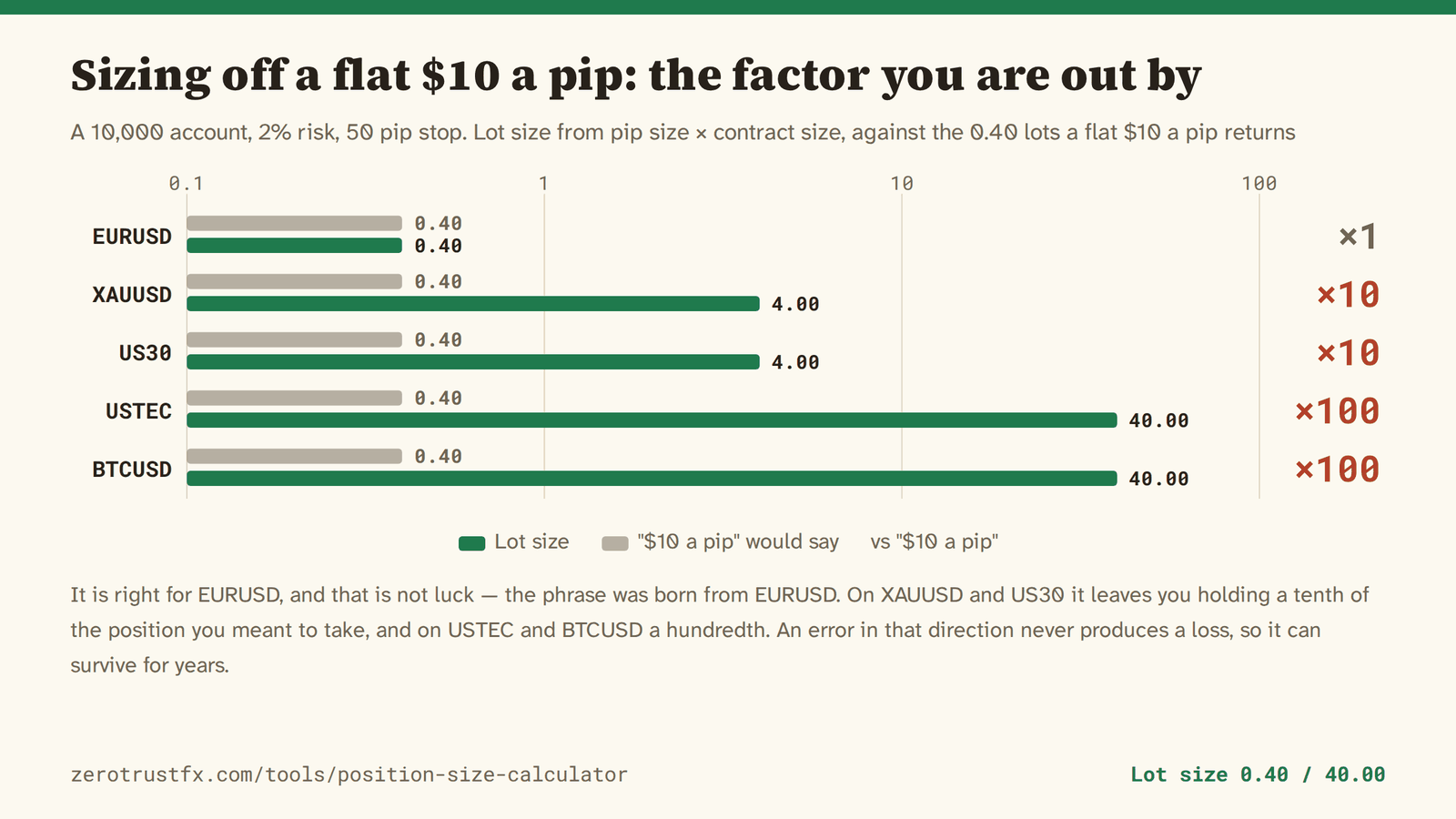
Take a 10,000 balance, 2% risk (= 200.00) and a 50 pip stop and the sizes come out 0.40 lots on EURUSD, 4.00 on XAUUSD and 40.00 on USTEC. Divide by a flat $10 a pip and all three come out at 0.40.
So anyone sizing off a flat $10 is holding 1/10 of the intended position on XAUUSD and 1/100 of it on USTEC. US30 is out by the same 10x as gold, and BTCUSD by the same 100x as USTEC. ★It is right for EURUSD and GBPUSD, which is not luck — the phrase was born from EURUSD.
Someone who says "I always risk 2%" and only changes instrument can end up holding 0.2% or 0.02% of what they meant to. An error in that direction never produces a loss, so it can survive for years. The other direction — moving to an instrument with a smaller pip size — announces itself on the first trade.
Where the account currency breaks it
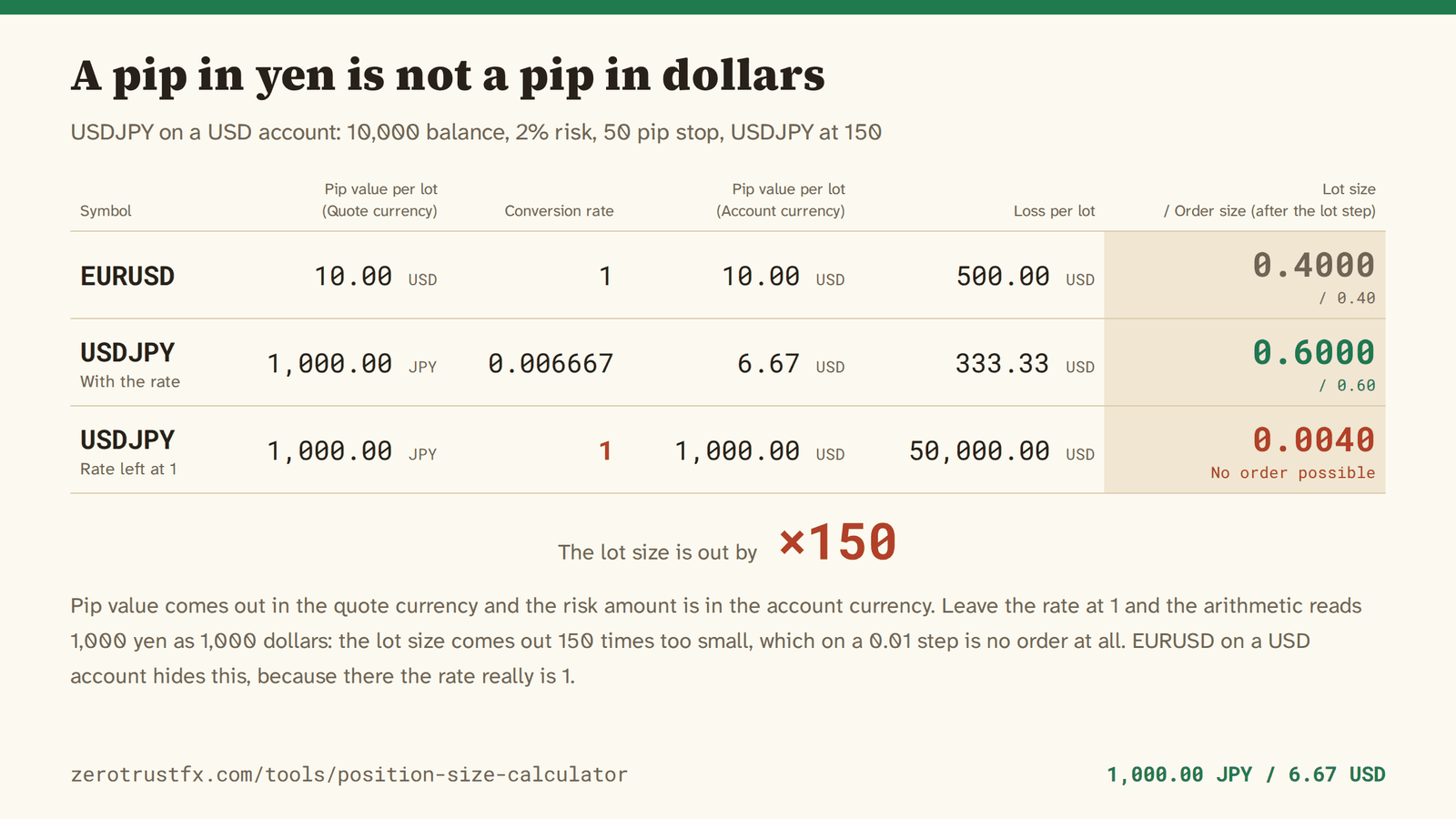
Pip value comes out in the quote currency: USD for EURUSD, JPY for USDJPY, USD for XAUUSD. Your risk amount, though, is in the account currency. Dividing one by the other is dividing two different units.
The conversion rate at the end of the formula exists for exactly that and nothing else: what one unit of the quote currency is worth in your account currency. Trading EURUSD on a USD account, it is 1. Trading USDJPY on a USD account it is what one yen is worth in dollars — 1 / 150 = 0.006667 when USDJPY is 150.
Leave it at 1 and here is what happens. A 50 pip stop on one USDJPY lot loses 50,000.00 yen, and the arithmetic treats that as 50,000.00 dollars. The lot size comes out 150 times too small. ★This page detects that state, keeps calculating, and says so in plain words. It does not quietly multiply by 0.006667 — it does not know today’s rate and will not pretend to.
Pressing a preset never fills the conversion rate. Contract size and pip size are contract specifications and barely move. The rate is the market and moves every second. Load both from one button and a stale rate ends up wearing the costume of a specification.
The size you can order is not the size you asked for
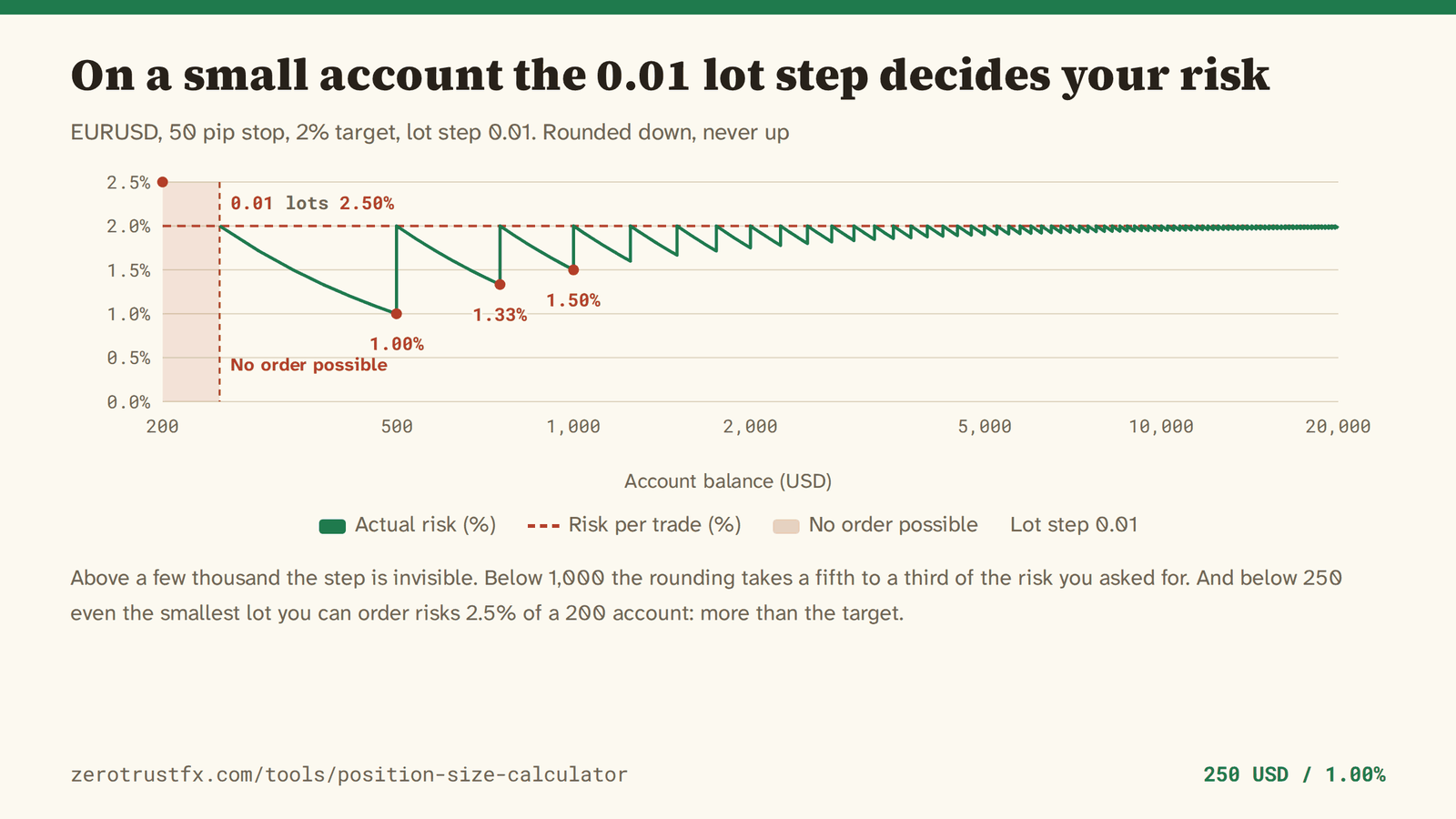
The formula produces a continuous number: 0.4037, or 3.8261. Brokers only accept multiples of a lot step — 0.01 on most accounts, 0.1 on some.
This page always rounds down. 0.4037 becomes 0.40. ★Rounding up would put you over the target risk the moment it happened. A tool for holding risk at 2% that quietly makes it 2.4% has inverted its own purpose.
Rounding down means the risk you actually take is smaller than the one you asked for, and this page always shows you by how much. Meaning to risk 2% and actually risking 1.98% is a small difference in money and not a small difference in whether you know what you are holding.
The gap grows when the size lands near the step. A 0.014 lot size drops to 0.01 and takes 71% of the intended risk. The smaller the account, the more the step coarseness bites. When the size does not even reach one step, this page refuses to print a number and says you cannot take the trade — because reaching for the minimum lot there is the moment you stopped sizing at all.
What this calculation assumes
It assumes your stop fills at your price. A stop order is an order that will certainly be executed; it is not an order that will be executed at that price. Once triggered it becomes a market order and takes whatever is there. Through a weekend gap, a data release or a thin session, the realised loss is larger than the risk you planned. Read the number above as a floor, not a cap.
It excludes the spread. If you measured the stop from your entry price, the round-trip spread is added on top of the loss shown. Spreads are variable and widen by multiples around news.
It excludes swap and commission. Hold a position for several days and swap is added to the loss. On the negative side of the carry, waiting costs more the longer you wait.
It excludes rejected orders and requotes. If the order does not go through in a fast market, you never got to exit where you planned to.
The contract sizes and pip sizes listed here were checked against the Exness help centre on 17 August 2026. Other brokers differ, and so can account types at the same broker. ★That is why both fields stay editable. Check them against your own platform before you use this. It is the only way to avoid the one mistake this kind of calculator exists to make.
The arithmetic
Risk amount = balance x risk%
Pip value per lot = pip size x contract size (in the quote currency)
Loss per lot = stop in pips x pip value per lot
Lot size = risk amount / ( loss per lot x conversion rate )
Order size = lot size rounded down to the lot step
Actual risk = order size x loss per lot x conversion rate
Check the contract size against your own account
The contract sizes and pip sizes on this page were taken from the Exness help centre. Other brokers differ, and account types at the same broker can differ too. The trading record published on this site is an Exness account.
※ This is an affiliate link: I earn a commission if you open an account through it, fund it and actually trade. That commission and a planned performance fee on a future copy-trading service are this site's only revenue — there is nothing else. Trading with leverage carries the risk of losing your money.
Frequently asked questions
How many units is one lot?
It depends on the instrument. One FX lot is usually 100,000 units of the base currency, XAUUSD is 100 ounces, XAGUSD is 5,000 ounces, and indices and crypto are 1 unit. "One lot" carries no quantity on its own — the contract size is what fixes it.
Is a pip the same as a point?
No. A point is the smallest price increment; a pip is a conventional unit. On a 5-digit EURUSD quote one pip is ten points. This tool uses pip size — 0.0001 for EURUSD, 0.01 for USDJPY, 0.1 for USTEC. How many digits your platform displays does not enter the arithmetic.
Where does the "$10 a pip" number come from?
From EURUSD: 0.0001 x 100,000 = 10. A number that is only true for one instrument became general advice. It is off by 10x on XAUUSD and 100x on USTEC.
Why is the contract size editable?
Because brokers disagree about it. Oil, gas and index CFDs vary the most. A calculator that hides the contract size behind a symbol picker will not tell you when its number disagrees with your broker. This one leaves the field open after the preset fills it.
What do I put in the conversion rate?
What one unit of the quote currency is worth in your account currency. EURUSD or XAUUSD on a USD account: 1, since both are quoted in USD. USDJPY on a USD account: what one yen is worth in dollars, so 1 / 150 = 0.006667 when USDJPY is 150. USDJPY on a JPY account: 1.
What if my account is in yen?
Then USDJPY and EURJPY need a rate of 1, and EURUSD or XAUUSD need the value of one dollar in yen — 150, for example. The two cases are exactly reversed from a USD account. Swap them and the lot size is out by a factor of more than twenty thousand.
The lot size is below my broker minimum. Can I just take the minimum?
Taking it puts you over your target risk. The page shows what that minimum lot would actually lose, so look at that first. Your real choices are a tighter stop, a deliberate decision to risk more, or skipping the trade. "It is the minimum, so it must be small" is a feeling, not a quantity.
Why round down instead of to the nearest step?
Because rounding up exceeds the target risk the instant it happens. A tool for holding risk at 2% that silently makes it 2.4% has inverted its purpose. Rounding down leaves you under the target, and this page always shows by how much.
Does leverage change the lot size?
No. Leverage sets the margin required, not the money lost. The loss is fixed by lot size, stop distance and contract size alone. Raising leverage does not change a single unit of the loss — it only changes whether the order can be placed at all.
Where is the required margin?
This tool does not show it. Margin = lots x contract size x price / leverage, and that needs a live price. This page never fetches prices. A number whose age you cannot establish is worse than no number.
Are spread, commission and swap included?
No. Every one of them pushes the realised loss above the planned loss and none of them pushes it down. Treat the output as a floor. For how much round-trip cost lifts the win rate you need, use the forex risk-reward calculator.
What happens if my stop slips?
You lose more than planned. A stop is an order that will be filled, not an order that will be filled at your price. Once it triggers it is a market order, and through a gap or a data release it can fill far away. What you lose is set by the price you actually got, not by the number on this page.
What risk percentage should I use?
This tool has no opinion; you type the number. But the larger the risk per trade, the more likely it is that the median outcome falls even when the expectancy is positive. That relationship is drawn out in the Monte Carlo equity curve simulator.
If I hold several positions at once, can each risk 2%?
Not safely. EURUSD and GBPUSD held together are closer to one large position than to two independent ones. Three trades the same way means three stops hit on the same bad afternoon. This tool sizes one trade; adding them up is your job.
Can I use this number as it is?
Only after you have checked the contract size and pip size on your own platform. Get those two right and the lot size is right. Get them wrong and nothing else can save the answer. And remember the output is the loss if the stop fills at your price.
Check this against a real record
Anyone can size a position correctly on paper. ZeroTrustFX publishes every trade before its outcome is known, cross-checked by an independent third party. Go and see how far planned risk and realised loss actually drift apart.
※ This is an affiliate link: I earn a commission if you open an account through it, fund it and actually trade. That commission and a planned performance fee on a future copy-trading service are this site's only revenue — there is nothing else. Trading with leverage carries the risk of losing your money.