The Verification Checklist
No machine can look at an FX account and tell you "real or fake". What exists instead is a set of facts anyone can verify for themselves. This page organises those facts into nine checks — a measuring stick, so that instead of trusting someone's verdict, you become the one who verifies.
It applies to anyone. Social-media traders, signal sellers, copy trading — and this site itself. Hold this measuring stick up to ZeroTrustFX too. These are the checks we run on ourselves every day, handed to you as-is.
Before or after?
UncheckedCompleteness of the record
UncheckedThe denominator
UncheckedThird-party verification
UncheckedRisk made visible
UncheckedConflicts of interest disclosed
UncheckedAbsence of solicitation
UncheckedAppeals to emotion
UncheckedLength of the record
UncheckedNothing verified yet. Work through the items above, one at a time.
This checklist does not judge, name or record any account. There is no name field by design — the instrument doesn't measure; you do.
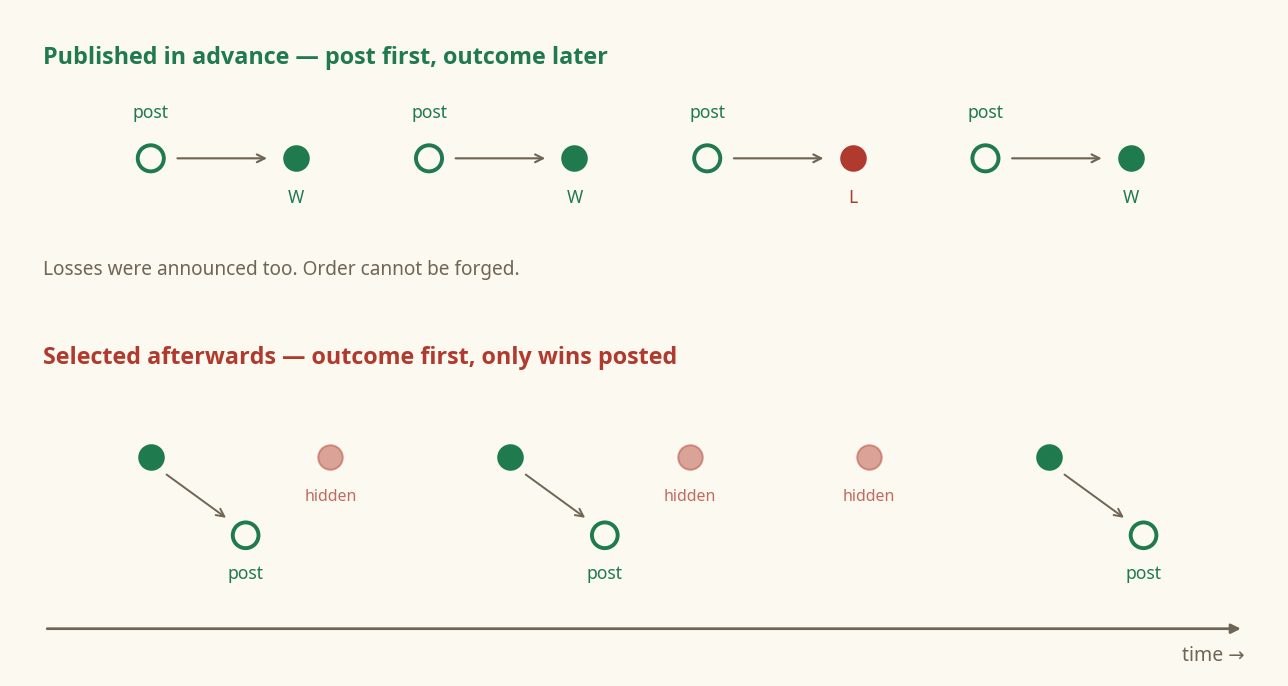
First, look at one thing only: before or after?
Time is the one thing that cannot be edited afterwards. If entries are published before the outcome, the record is at least not a curated past. If every post comes after the outcome — then however high the win rate, it is not a track record; it is editing. Most fake results are made not by faking wins, but by hiding losses.
The denominator test
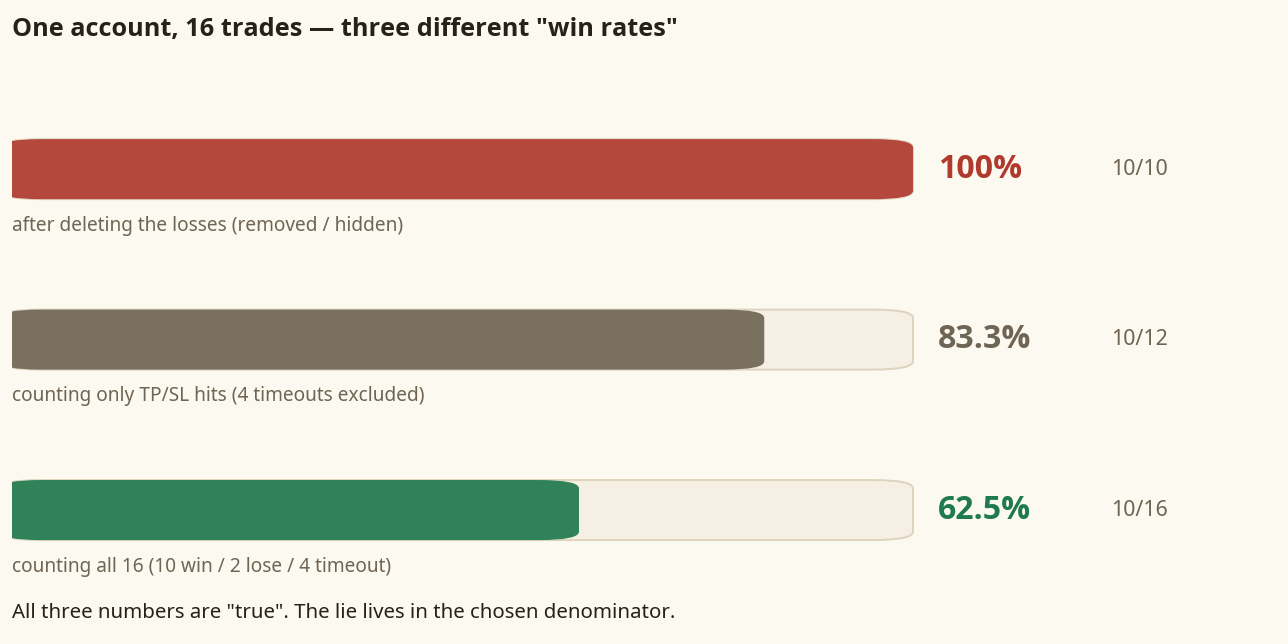
When you see "83% win rate", ask by reflex — out of how many? A win rate with no denominator is theatre in the shape of a number. The figure below shows the same 16 trades from the same account. By choice of denominator alone it becomes 100%, 83.3% or 62.5%. All three are arithmetically true. That is why the unspoken denominator is where the lie lives.
The trust audit — a screenshot is not evidence
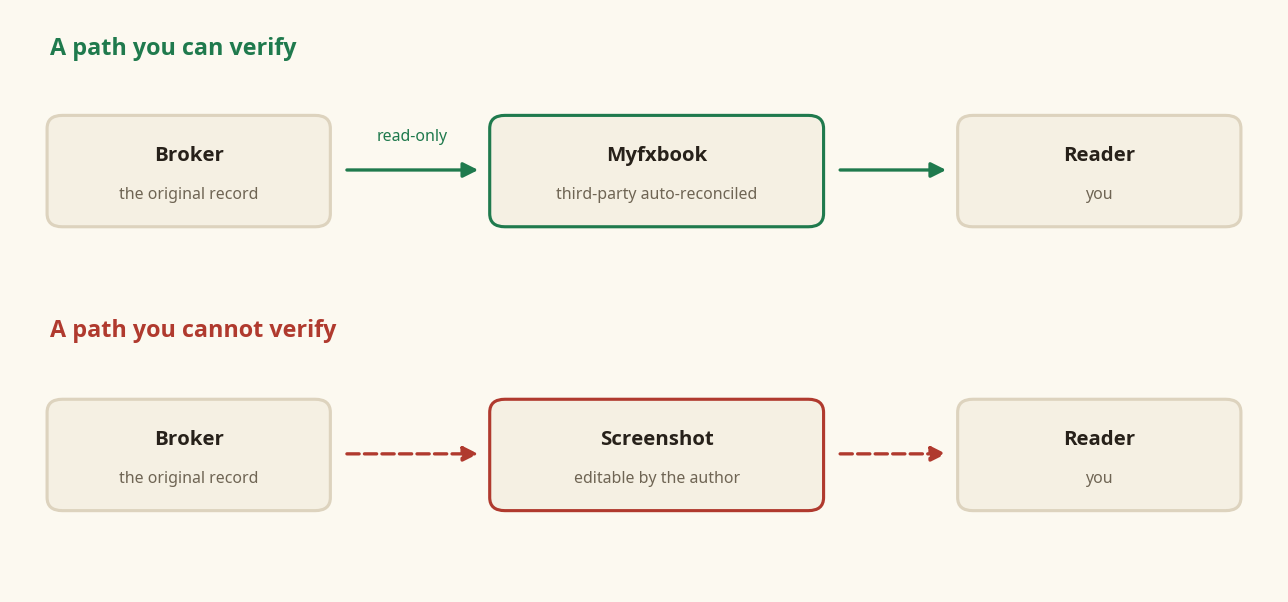
Result images are made on the author's own computer, by the author's own hands. Evidence that passed through an editable place is not evidence. What matters is not the image but the path. A record wired read-only from the broker to a third party (such as Myfxbook) has nowhere for the author's hands to enter. That is the whole trust audit — one question: did this pass through the author's hands anywhere?
Red flags — the lies that live outside the numbers
Everything so far was about the record. The remaining lies are placed outside it. A "special invitation" arriving by DM. An offer to trade on your behalf. Private WhatsApp or Telegram groups. Photos of cash and rented supercars. They share one property: they skip verification and reach straight for your trust. Remember this — people with a real record ask you to verify. People without one ask you to believe.
Emotion outruns verification
Sales-letter technique is systematised — you can buy it in a bookshop: reciprocity, scarcity, authority, liking. In FX it arrives as "I started to pay my sister's tuition", "I support my family", "part of the profits goes to charity", "today only", "3 spots left". None of these is necessarily a lie. The problem is placement. When a touching story unrelated to trading sits where the track record should be, it is trying to outrun your verification with your empathy. Emotion speeds decisions up; verification slows them down. The harder a publisher pushes you to hurry, the slower you should read. When you are told a story, return to the record — that alone disarms the entire toolbox.
What these nine checks measure — and what they don't
Let us be honest. These nine are a score for honesty, not a guarantee of profit. A trader can pass all nine and still lose. The reverse does not exist: without the nine, you have never actually verified anything. What this checklist promises is not "you will find a profitable account" — it is that you will not pay for lies with your time and money. FX scams change their tricks every year; the unverifiable structure underneath never changes.
If you remember only one line
On days when nine checks are too many, take just this: "Show me the record. All of it, published before the outcomes." Most of the nine checks are folded into that one sentence. The real thing welcomes the question. The fake changes the subject.
Frequently asked questions
Can this tell me whether an account is a scam?
No. It measures whether a publisher can be verified — it does not pronounce anyone a fraud. That said: if nothing can be verified and yet you are being asked for money or membership, that is the classic shape of a scam. The judge is not this tool; it is you, after the checking is done.
If the win rate is high, is it real?
No. A win rate is a number you can manufacture by choosing the denominator. Delete the losses and it is 100%; drop the timeouts and it is 83%; count everything and it is 62.5% — same account. Look for the denominator, not the height of the number.
Do screenshots of results count as evidence?
No. Images are editable by the very person showing them, and a faked screenshot is visually identical to a real one. What can be distinguished is the path: a record connected read-only from the broker to a third party such as Myfxbook has no place for the author's hands.
If all nine pass, will I make money?
No. The nine are a score for honesty, not a guarantee of returns. There are traders who publish honestly and lose honestly. What passing the checks buys you is a decision made on true information — nothing more.
Why does "cannot verify" count as "no"?
Because trust comes after verification. The moment you start filing unverifiable things under "probably fine", the checklist stops working. If a publisher is genuine, they can republish in a verifiable form. Ask instead why they haven't.
Does ZeroTrustFX itself pass these nine?
We publish no self-score here — nothing is less credible than a page grading itself perfect. Hold this measuring stick up to this site: every trade is at the full record with the post that preceded its outcome, and the account is connected read-only to Myfxbook. The check takes a few minutes.